Service review No. 3 · Oct 16, 2026 · 12 min
Numa review. AI platform for dealership service: missed calls, live CSI and sales
What Numa does, why it came to dealers through service and not through sales, what dealers say, and what to ask before you sign. Company claims are kept apart from checked facts.
Podium and Impel come to a dealer through sales. Their AI answers a website lead and invites the buyer to a test drive. Numa came from the other side, through the service phone. A missed service call is easy to count, and you see the money behind it in a week. With this one pain, the company grew to about one and a half thousand dealerships.
I did not work inside the system. Only customers can log in. I studied the Numa site, dealer case studies, articles in TechCrunch, WardsAuto and trade media, and interviews with the founder. Every picture below comes from the company site. These are marketing mockups, not live screens.
In short
- Numa is a US platform that takes over customer calls and messages for car dealers. The company calls itself "The AI Operating System for Car Dealerships."
- Its main area is service. The AI answers calls, books repairs, tells customers the status of their car, and finds unhappy customers while they are still in the store.
- In April 2026, Numa bought the startup Ficus and moved into sales. Ficus reviews sales calls and shows what each salesperson needs to learn.
- The press confirms the funding and the investors. Almost all result numbers come from the company. Only one case is confirmed by an outside source. WardsAuto reports it in the dealer's own words.
- TechCrunch asked the hardest question. Whose conversations does Numa use to train its models? The CEO did not answer.
Where Numa came from. The team closed its first product and moved to dealers
The legal name is NumberAI. It started in 2017 in Oakland, California. The founders are Tasso Roumeliotis (CEO), Andy Raff, Joel Grossman and Steven Ginn. The same four people built Location Labs before, and the antivirus company AVG bought it for $220 million (TechCrunch).
At first, Numa made AI messaging for any local business. Then the team closed that product and kept one industry, car dealers. TechCrunch calls this a good pivot.
In 2024 the company raised $32 million in a Series B. Touring Capital and the Japanese company Mitsui led the round. Mitsui is one of the largest shareholders of the Penske dealer group. At that time Numa had 70 employees and 600 dealers (TechCrunch, SiliconANGLE).
In April 2026 the company said its revenue grew 200%. It had more than 1,300 dealers and had raised $55 million in total (DigitalDealer). Now the home page says "Trusted by 1,500+ dealerships." This is the company's claim. I could not check it.
The main screen. The customer, the car and the repair order in one window
The first thing the site shows is a chat between a customer and a dealer. The customer asks about a ski rack for her Trailblazer. The AI answers for the store and at the same time asks the parts team if the rack is in stock. On the right you see the car and the repair order number.

This mockup shows the main idea of Numa. The talk with the customer and the work inside the store happen in one feed. An employee does not jump between the phone, email and the dealer management system (DMS). They do not need to look up who the customer is and what is going on with the car.
Voice AI. An AI voice that knows the customer before it answers
Voice AI takes incoming calls. The company stresses that it sees the customer history in the DMS in real time. So before it answers, it already knows the car, the last visit and the open repair order.

On the FAQ page, the company explains how this is different from a simple phone assistant. A simple assistant says hello and transfers the call. Numa solves the request. For example, it tells the customer that the car is waiting for a part and will be ready on Thursday. Or it books the customer into a free service slot and writes the booking back to the DMS.
Smart Inbox. All calls and messages of the store in one feed
The second product is one shared inbox for service, sales and the BDC. It has calls, text messages and messages from the mobile app. AI agents answer customers right inside this feed.
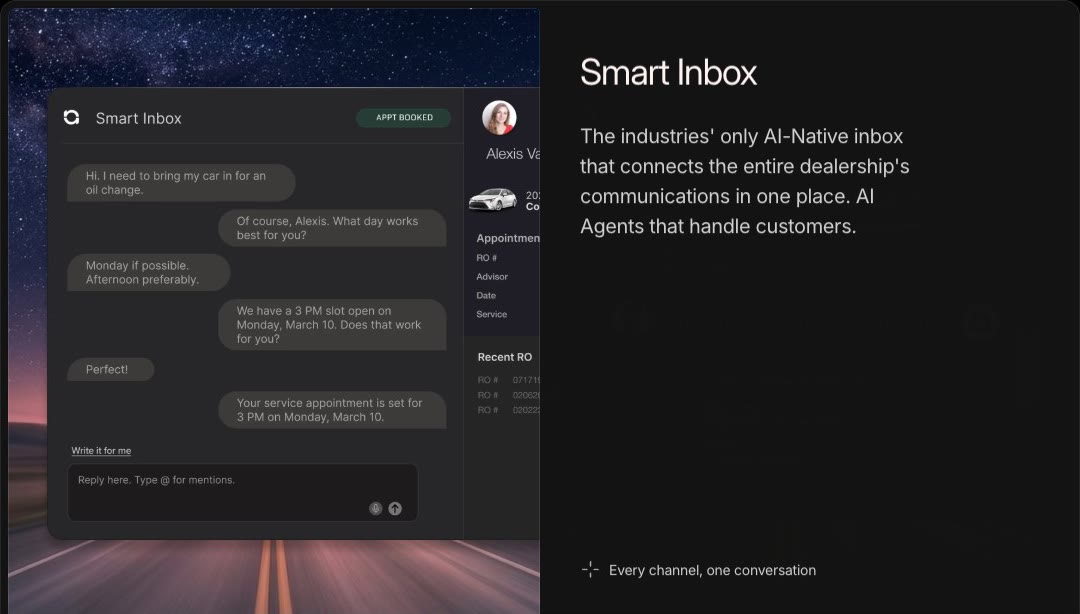
The chat in the mockup is short. The customer wants an oil change. The AI asks about the day, offers Monday at 3 PM and confirms the booking. At the bottom there is a "Write it for me" button for an employee who answers by hand.
Email and website chat are not in the list of channels. If your customers write mostly through the website or messengers, ask about this in the demo.
LiveCSI. Customer satisfaction in real time
CSI is the customer satisfaction index. Usually it comes from a survey that the customer fills in a week after the visit. When a bad score arrives, it is too late to fix anything.
Numa offers to measure customer mood in every call and message. The company calls LiveCSI "your dealership's heart rate monitor."
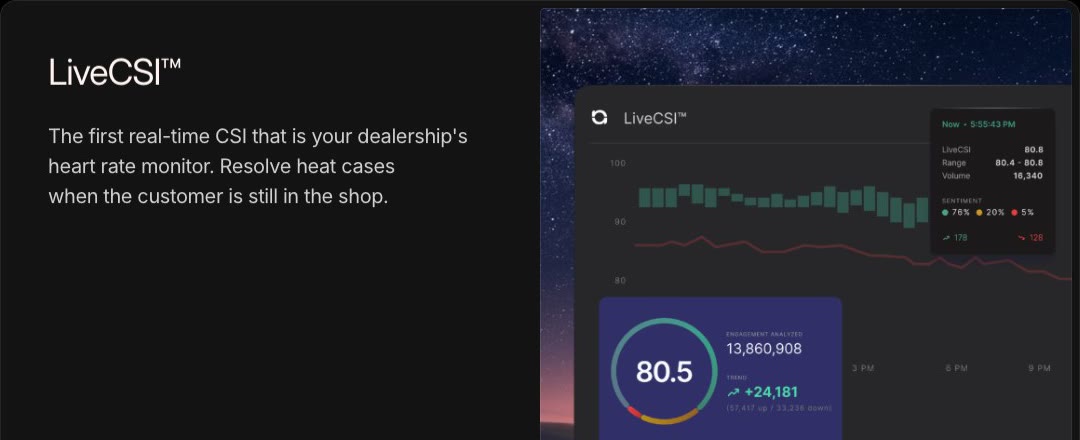
The score in the mockup is 80.5. On the right you see the share of conversations by mood. 76% are positive, 20% neutral and 5% negative. These numbers are only an example, not a real store.
LiveCSI works together with the Heat Case Agent, an agent for angry customers. It notices a conversation that goes badly and calls a manager before the customer leaves to write a complaint. The company says this keeps 70% of these customers.
Agents for the service advisor
The Service Advisor Agent works for the service advisor. It writes the reply to the customer, shows the full history and reminds the advisor whom to call back.
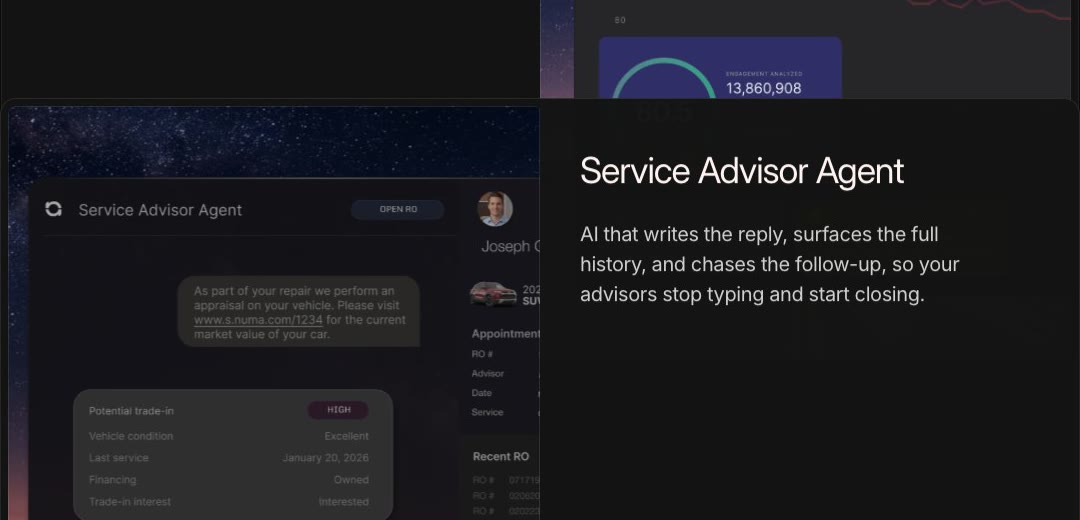
There is an interesting detail in this mockup. During a repair, the agent offers the customer a free appraisal of the car and marks a "potential trade-in" with high priority. This is how service passes the customer to sales.
Three more tools are shown as cards. A mobile app, so the team can answer calls and messages away from the desk. The Heat Case Agent for conflicts. And the Opportunity Agent, which finds declined work in the data and books the customer for it.

Ficus. How Numa moved into sales
In April 2026, Numa bought Ficus. Lucas Florence started this company in 2024 (Auto Remarketing). The Numa CEO said that before the deal, the company worked mostly in service and had little reach into sales.
Ficus does not answer customers instead of a salesperson. It reviews every sales call, shows which skill each person must improve and gives examples from the best calls of the team. It also shows why a deal closed or stalled (Ficus page).
The Numa home page does not mention Ficus yet. The company gives no sales numbers.
What Numa says about itself and what is checked
The home page shows three big numbers. More than 1 billion calls and texts handled. An appointment booking rate of 80%+. And 70% of heat cases resolved.
The FAQ adds two more. Response time drops from 23 hours to under 10 minutes, and repair order dollars per advisor grow by more than 35%.
Here I keep the facts from other sources apart from the company's words.
| Checked by other sources | Company claims only |
|---|---|
| Founders, year, sale of Location Labs for $220M (TechCrunch) | 1,500+ dealerships, revenue up 200% |
| $32M round, investors Touring Capital and Mitsui (TechCrunch, SiliconANGLE) | 80% booking rate, 70% of heat cases resolved, 10 minutes instead of 23 hours |
| Purchase of Ficus in April 2026 (Auto Remarketing, AutoSuccess) | 35% more repair order dollars per advisor |
| Team Gillman case in the dealer's words (WardsAuto) | All case studies on the site and "90% DMS coverage" |
| The CEO did not answer about training data (TechCrunch) | Go-live in 2–3 weeks |
What dealers say
There are few independent reviews. On the industry forum DealerRefresh, Numa has a page but no discussions. I did not find dealer complaints in open sources.
The most useful source is WardsAuto. The magazine talked to dealers directly. Team Gillman Auto Group in Houston reached 55% of 1,023 customers with missed calls and got 190 service appointments. Tacoma CDJR likes the link with the DMS. Customer history now comes in without delay.
A case worth reading in full. Dyer's second try with AI
The most useful case on the Numa site came out on October 14, 2026. Dyer Automotive Group first used voice AI from another company. Six months later, customer scores fell a lot. Jay Holmes, VP of Fixed Operations, says the people at that provider were not car people. There was almost no training at launch (Dyer case).
Then Dyer sorted its calls by reason and by mood. 63% of calls came from customers who only wanted to know if their car was ready. More than 40% of callers were angry. The top complaint was simple. Nobody called me back.
The second try was built around this finding. Service advisors see open repair orders, a queue of whom to call or text, and the time of the last update. Dyer reviews Numa results in daily reports and weekly meetings together with gross profit. Advisors say that if it is not in Numa, it did not happen.
The case gives no result numbers. But the idea is useful for any service department, with AI or without it.
No price on the site. What to ask before you buy
Numa does not show a price. You can buy only after a demo. The company promises go-live in 2–3 weeks and says most teams work well in the system within 90 days.
Here is what I would ask before signing.
- Customer conversations. Whose conversations do you use to train your models? Are my customers included, and can I say no?
- DMS link. Do you work with my DMS? How long does the connection take, and what will the AI write into it?
- Channels. Does the AI work with email, website chat and messengers, or only with phone and text?
- How you count results. What do "80% booking rate" and "70% of heat cases resolved" mean? Out of how many calls, and for what period?
- Sales. What part of Ficus works in my country and my language? Do you have case studies from sales teams?
What to take for yourself, even if you do not buy Numa
Sort your service calls by reason. Take the last hundred calls and group them by topic. If more than half are "is my car ready," you do not need AI first. You need a rule to send repair status before the customer calls.
Count missed calls. Ask for a phone report for one week. How many service calls had no answer, and how many of those customers got a call back?
Catch unhappy customers before the survey. Give one person a daily task. Read yesterday's bad conversations and call those customers. A CSI survey a week later fixes nothing.
Start with one pain. Numa did not sell dealers "AI transformation." It sold a simple promise. On Monday you have a hundred voicemails, and by lunch they are gone. When you change something in a store, start with one problem where you can see the result in numbers in a week.
Videos worth watching
- How AI Agents Are Extinguishing Service 'Heat Cases' and Protecting Dealership Profitability. Car Dealership Guy, 36 minutes. Roumeliotis talks about angry customers and when AI should answer the phone.
- Run Your Dealership with AI Agents. Ted Ings' Fixed Ops Roundtable, 28 minutes. Derek Simonds from Numa explains how agents work in service.
- Numa. The AI Drive. Dealer Service Training. Numa channel, 15 minutes. Training for service teams, with the interface on screen.
- Automotive AI Cagematch With 4 Top CEOs. Car Dealership Guy, 72 minutes. Numa, Podium, Toma and Mia in one show.
Who Numa fits and who should look at others first
Numa is strong where Podium and Impel are weaker. It came through service, it is deeply linked with the DMS, and it sells a result you can see in your phone reports. Its weak points are also clear. There are few independent numbers, sales is only starting, and the company did not answer the question about customer conversations.
If service calls in your store go unanswered and advisors spend half the day on the phone, look at Numa first. If your main task is night leads in sales, look first at the companies that came from sales.
Read next
- Oct 16, 2026
Service review No. 4CallRevu review. A platform that analyzes dealership calls and trains salespeopleWhat CallRevu does, how it differs from AI that answers the phone itself, what dealers say, and what to ask before you sign. Company claims are kept apart from checked facts.13 min - Oct 10, 2026
Service review No. 1Impel review. What the AI platform for car dealers does and what to check before you buyA review of Impel based on its website, demo chats, case studies and dealer opinions. Six modules, what is confirmed, my opinion, and what to ask before you sign.21 min - Oct 10, 2026
Service review No. 2Podium review. AI sales agent Jerry and manager agent OperatorWhat Jerry does in sales and service, why a manager needs the Operator agent, what dealers say, and what I think about it. Screenshots from the site, company claims kept apart from checked facts.17 min