Service review No. 2 · Oct 10, 2026 · 17 min
Podium review. AI sales agent Jerry and manager agent Operator
What Jerry does in sales and service, why a manager needs the Operator agent, what dealers say, and what I think about it. Screenshots from the site, company claims kept apart from checked facts.
Podium has a trick worth studying apart from the product. The company does not sell a "lead reply module." It sells an employee named Jerry. Dealers "hire" him, "train" him, and correct his mistakes. For a store manager, this is easier than buying one more piece of software.
I reviewed the Podium site for car dealers. I read the sales and service pages, the company's article about the California law, case studies, videos, and dealer comments on an industry forum. There is no customer account in this review. Only customers can log in, so every picture below comes from the company site. These are marketing mockups of the interface, not live screens.
In brief
- Podium is a U.S. messaging platform for local business that became an AI service. Car dealers are its largest industry.
- Jerry talks to customers in sales and service. He books test drives and answers calls. Operator talks to the manager. It finds missed sales and prepares drafts.
- The main numbers are company claims. I found no independent measurements.
- Dealers on the forum have mixed views of the AI part. They praise the review tools more often.
- I like how Podium presents Jerry. In my view, Operator for the manager is a little unnecessary. What worries me most is that the product needs deep integration.
- Podium wrote a detailed guide to the California law on price in the first message. A vendor rarely explains where its own product can put a dealer at risk.
Where the company comes from
Podium was founded in 2014 by Eric Rea and Dennis Steele in Utah. The first name was RepDrive. They started with review requests for local business, not with cars (Wikipedia)).
In November 2021, the company raised $201 million at a $3 billion valuation (TechCrunch). In the market for dealer AI assistants, this is an old company. It has a customer base, links to dealer systems, and 13 years of conversations to train models on. That is what the company says.
On its dealer site, the company says more than 6,000 stores trust it. It also says one in four U.S. dealers works with it. I could not check these numbers.
Two roles in one system. Jerry talks to customers, Operator talks to the manager
This is the most important difference, and the company states it on its FAQ page.
Jerry works with customers. He answers sales and service leads by SMS, website chat, social media, email, or phone. He keeps the conversation going and books the visit.
Operator works with the manager. It is a second agent, shown as a helper for the dealership's general manager. You can ask it a question in plain English, by text or voice. It reads conversations, calls, and store numbers, then suggests what to do.
The company says Operator sends nothing without approval. It drafts campaigns, follow-ups, and coaching notes. They go to customers only after the manager approves. Later, you can allow it to do more.
Jerry in sales. What he does and what the pictures show
The sales page promises "more test drives, more cars sold." The idea fits in one line. Other AI tools send one message and stop. Jerry confirms the car by VIN, books the test drive, and follows up until the deal is done.
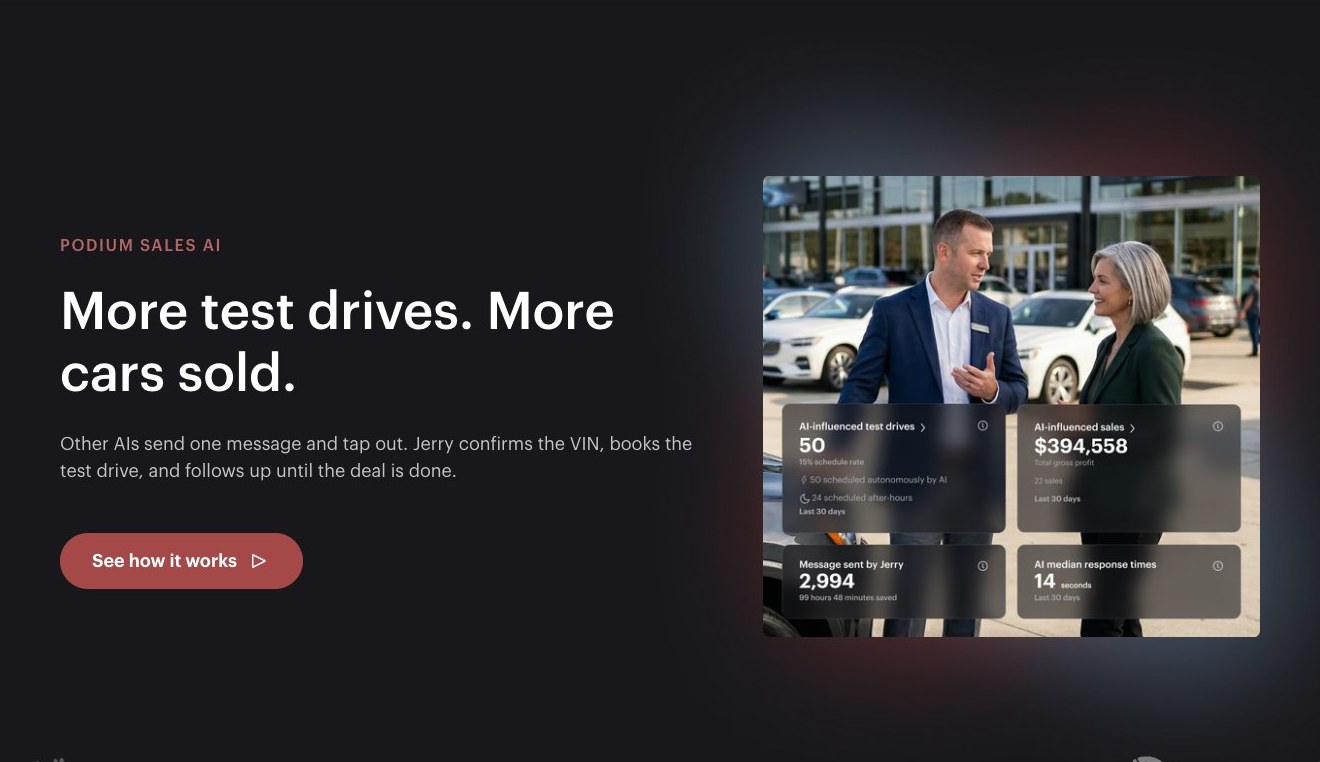
The mockup shows four numbers for 30 days. 50 test drives with AI involved, 24 of them after hours. $394,558 in gross profit from sales that AI influenced.
It also shows 2,994 messages sent and a median response time of 14 seconds. These numbers come from a demo screen, not from a real store.
Podium lists these abilities for Jerry in sales.
- It answers every inbound lead in about 36 seconds and follows the dealer's playbook.
- It knows the store's stock, policies, and sales process. It does not answer "let me check."
- It books the test drive and writes back to the CRM with no human handoff.
- It searches the customer base for equity, lease ends, and trade-ins.
- It can show manufacturer offers, video messages, iPacket links, and live stock.
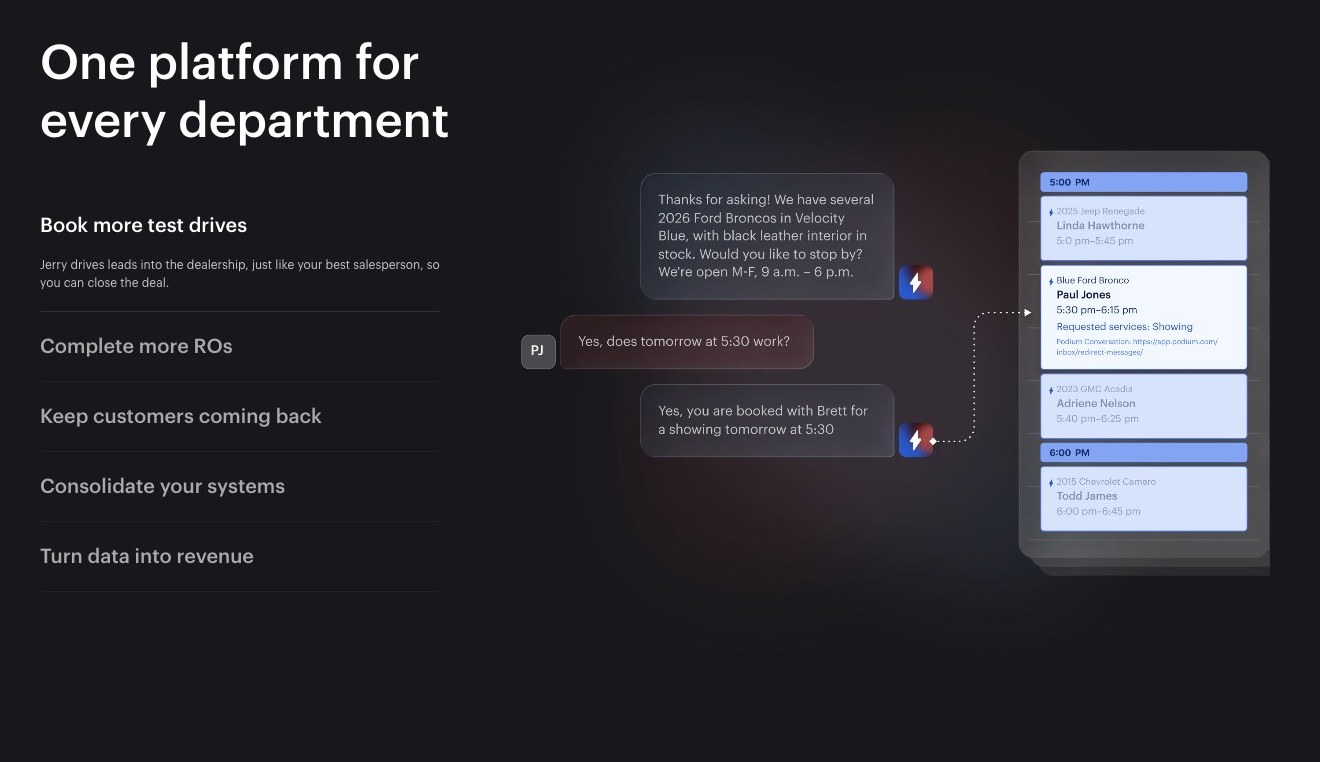
The dialog in the mockup is short and good. The customer asks about a Ford Bronco. The AI names the color, the interior, and the opening hours, and invites the customer to visit. The customer picks a time.
The booking appears on the salesperson's calendar. The key point is clear. The talk leads to a visit, not only to answers.
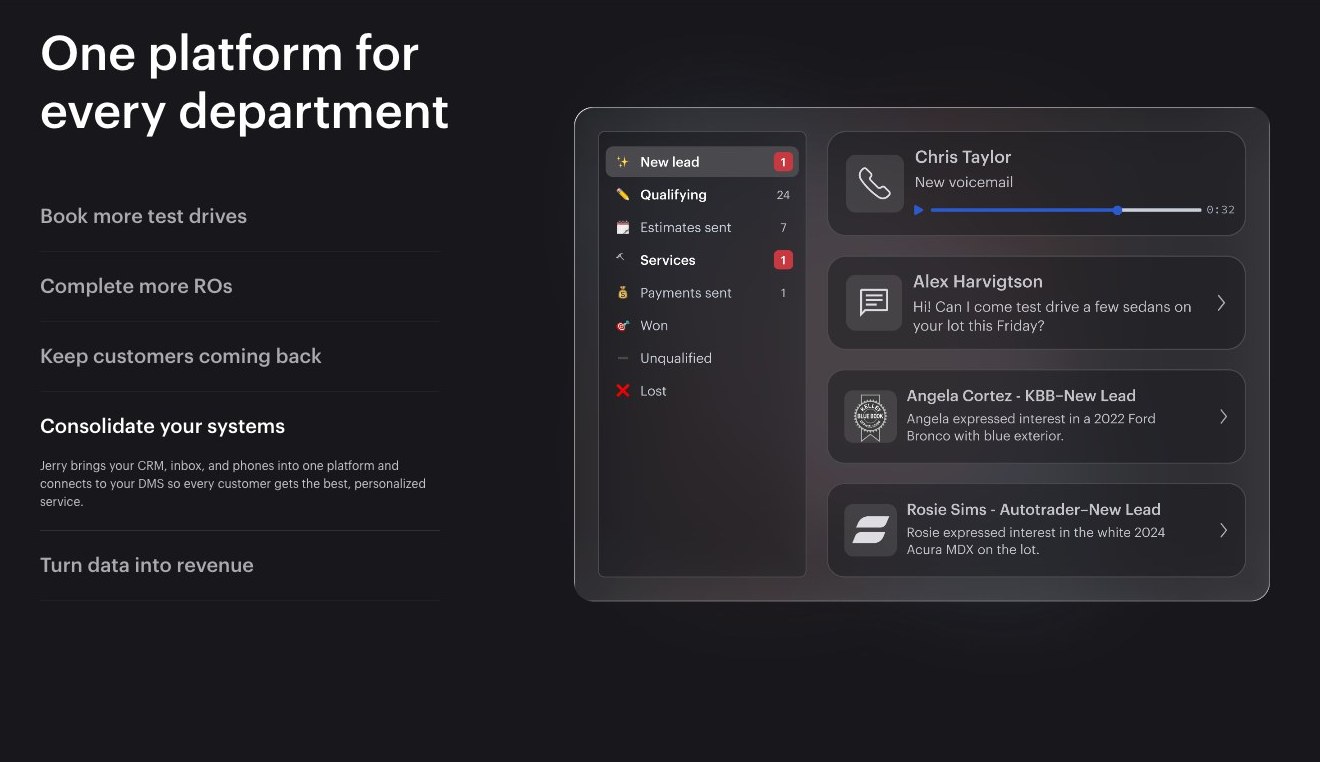
The second screen is about having everything in one place. On the left are the customer stages, from new lead to won deal. On the right are a voicemail, a website chat, and leads from KBB and Autotrader. For a manager, this is the most concrete benefit. One inbox instead of three.
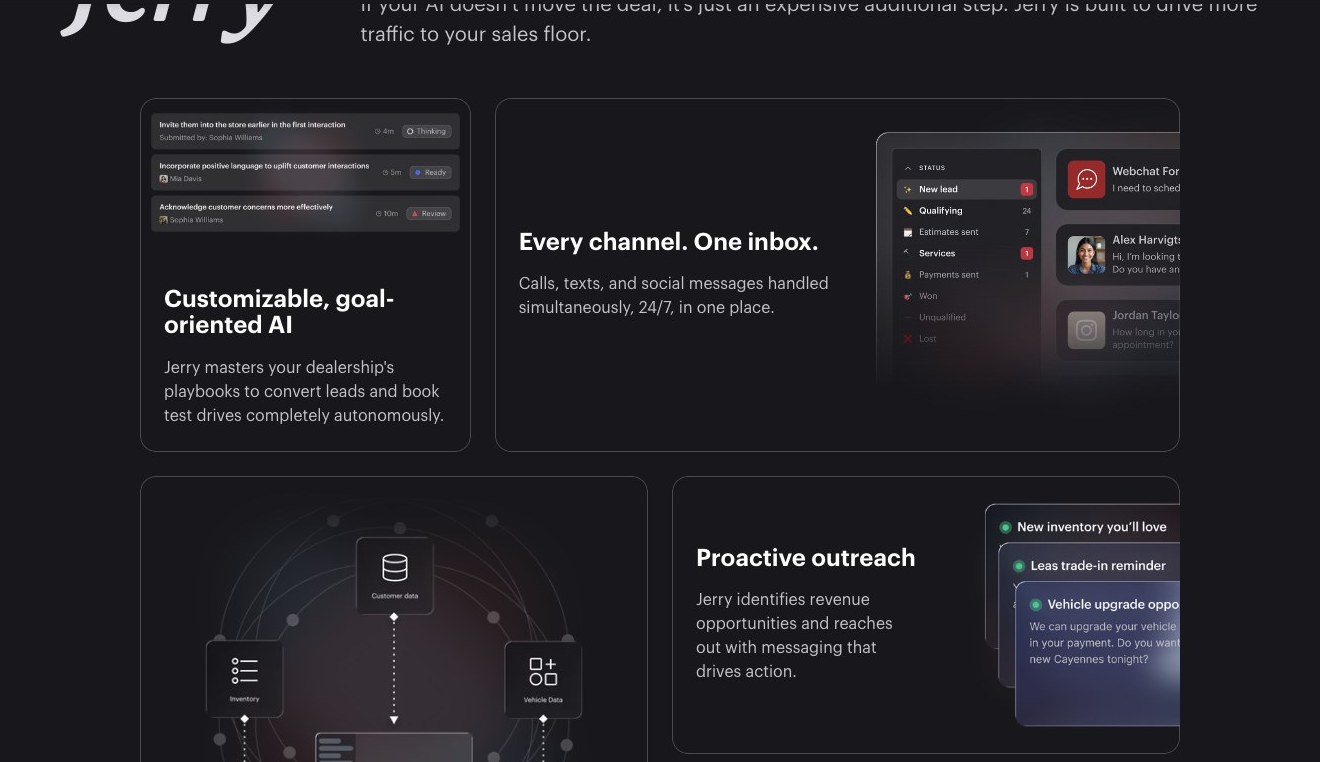
On the sales page, the left block is about setup. The manager writes notes in plain English. One example is "invite them to the store earlier." A list shows the state of each note. Thinking, ready, or in review. The company says the change applies at once.
Jerry in service. Calls and the database
For service, the company focuses on calls. The page says service centers miss 40% of calls. Jerry answers each one and books the repair order straight into Xtime or Tekion. If a human is needed, he transfers the call with a short summary of the talk.
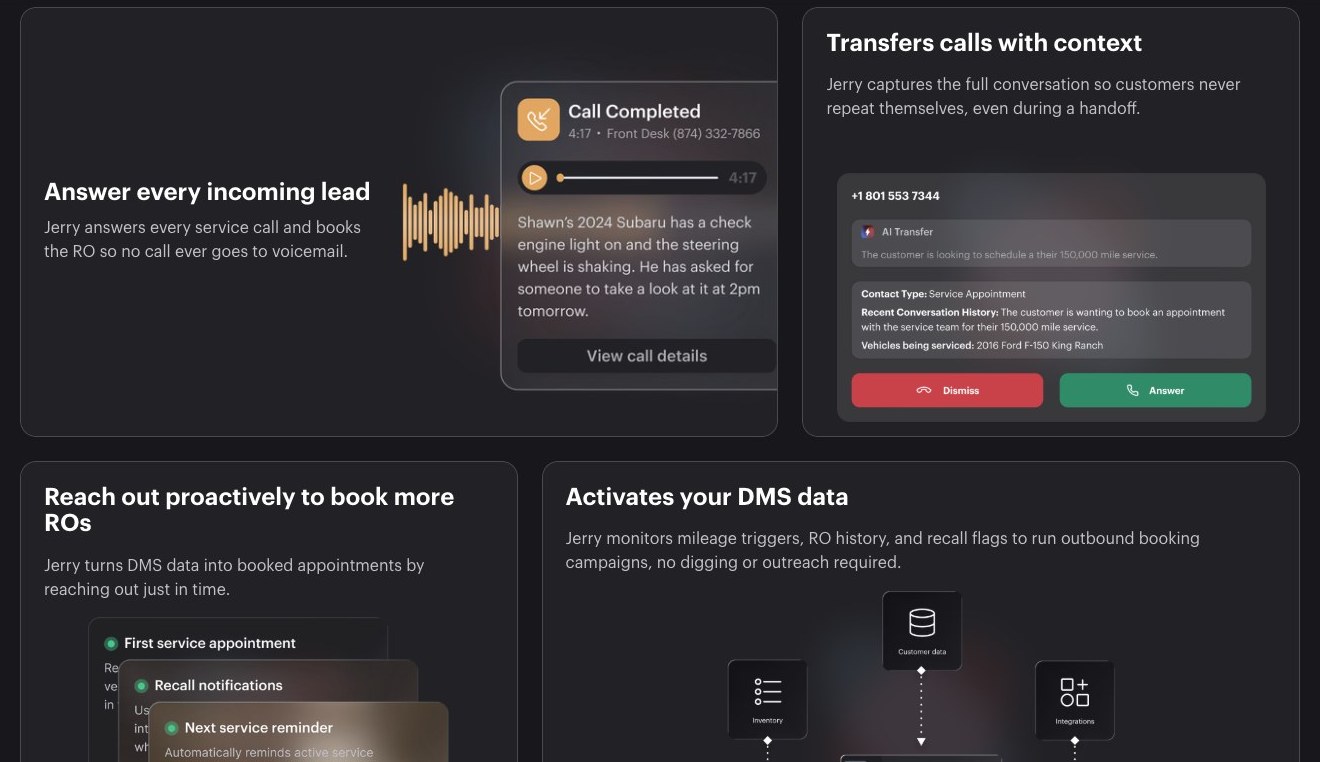
On the left of the mockup is a call transcript. The customer reports a check engine light and a shaking steering wheel, and asks for a look at 2 p.m. tomorrow. On the right is the handoff to a live employee. The screen shows what the customer wanted and which car it is, so the customer does not repeat the story.
The second half of the service story is proactive campaigns. Jerry watches mileage, repair order history, and recall flags in the dealer's system. He writes to the customer on his own when service is due, or when the customer declined a repair and did not come back.
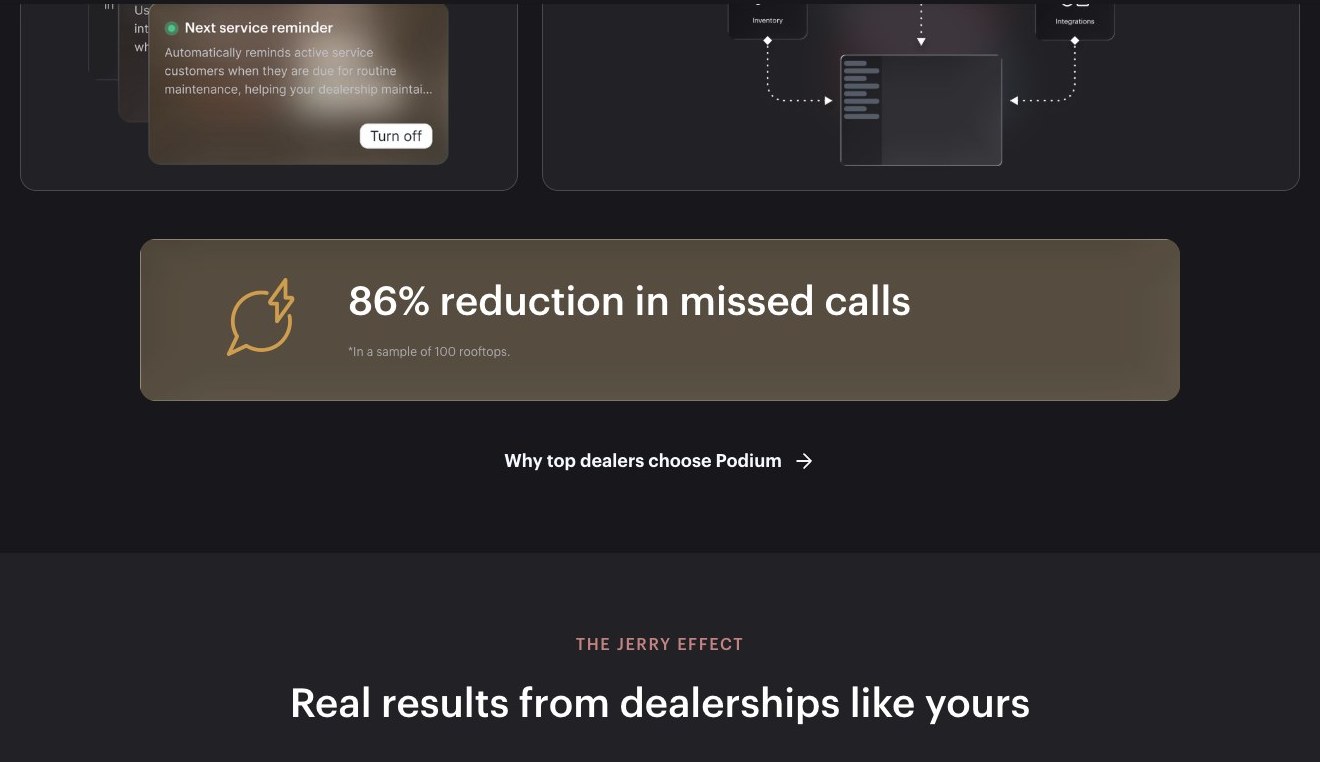
These are the numbers the company puts on the service page. 87% of calls are fully handled by AI, with no human transfer. 67% better show rate after AI follow-up. 86% fewer missed calls in a sample of 100 stores. Each has a small note that it is the company's sample.
Operator. An agent you can ask a manager's question
Operator is the newest part and the most interesting one.
In the mockup, the manager writes one line. "Pull our unsold leads and open service opportunities. Flag the ones that need follow-up. Write a message to each."
The agent answers with two blocks.
On the left is a summary. 42 leads with no contact for more than five days. 31 customers who declined service or did not book. 18 high-intent customers who may go to a competitor. On the right are draft messages, saved as drafts that need approval before sending.
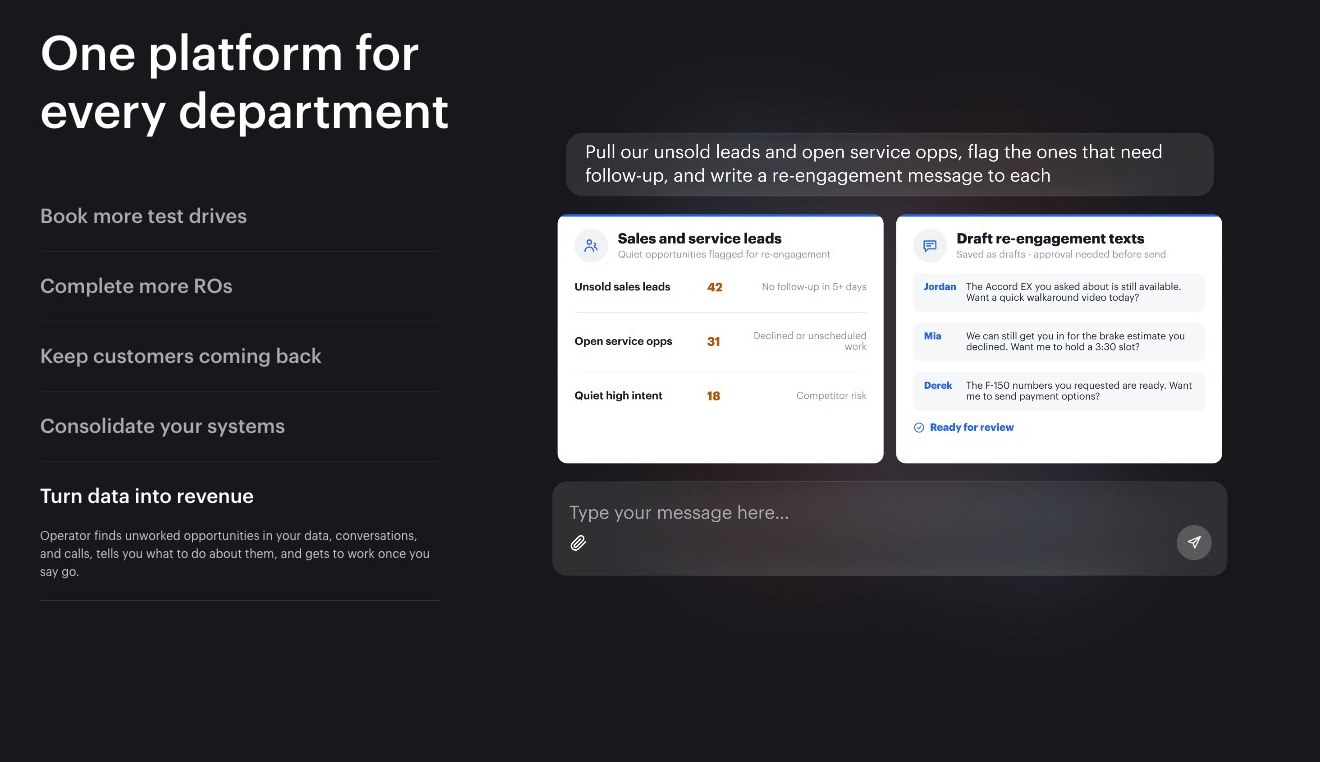
The drafts are good. "The Accord EX you asked about is still available. Want a quick walkaround video?" "We can still get you in for the brake estimate you declined. Want me to hold a 3:30 slot?" They are short, they name the subject, and they offer one action.
The FAQ page shows the limits.
- Operator works with what is already in Podium. Conversations, calls, CRM, and service records from the DMS, if connected.
- It does not see a customer who called a different number or walked in. That visit must be logged in the system first.
- Nothing goes out without approval.
- Service data needs a DMS connection, and coverage depends on the account.
What Podium says about itself, and what is checked
The company shows a table, "your current system versus Podium." I kept it as is. A salesperson who reads the site will hear the promise this way.
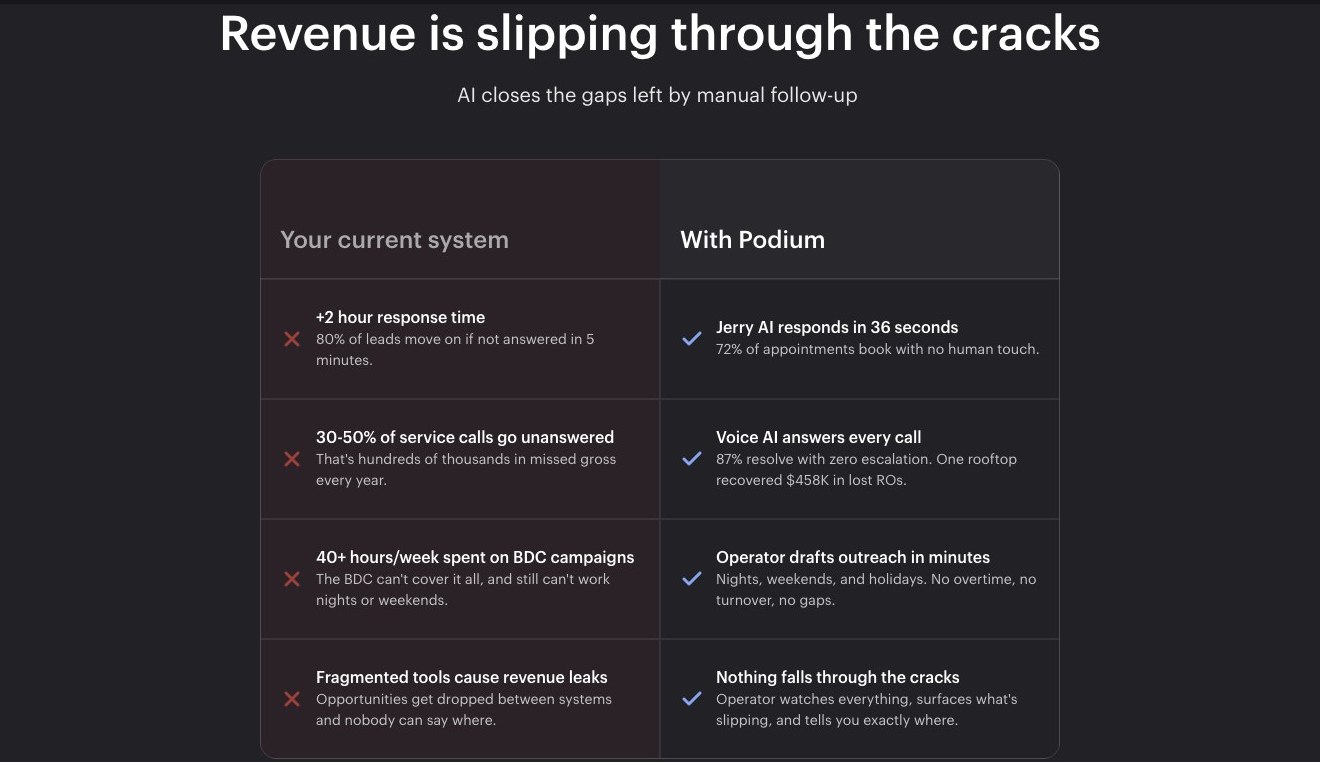
Now let us separate what is confirmed from outside from what the company says.
| Confirmed independently | Company claim only |
|---|---|
| Founders, year, $201M round (TechCrunch) | 6,000+ dealers, one in four U.S. dealers |
| 4.2 out of 5 on 526 reviews, all industries (GetApp) | 36-second reply, 87% of calls with no human |
| Complaints about contract auto-renewal (GetApp) | 40% better conversion, 39% of test drives from AI follow-ups |
| Dealer doubt about the AI part (DealerRefresh forum) | 86% fewer missed calls |
| A court case about SMS and a Utah venue clause (TCPAWorld) | All customer cases on the site |
What dealers say
On the DealerRefresh forum, Podium has 18 mentions. Seven are positive and two are negative. Dealers mostly praise the review tools. On the AI side, views are harsher.
A dealer called Rob wrote in December 2024 that Podium's AI has potential. About the competitor Impel, he said its AI should be taken behind the shed. Another dealer in the same thread replied that both are bad.
On GetApp, Podium has 4.2 out of 5 on 526 reviews across all industries. One repeated complaint is about the contract. One executive wrote that Podium kept charging the company for six more months after the request to cancel. Another says Podium refused to cancel and pointed to a four-year-old contract with auto-renewal.
I do not think you should rely on the contract complaints. They do not worry me much. I care more about the product, how to set it up, and how useful it is.
The California law that pushed Podium into the open
Since October 1, 2026, California's SB 766, the CARS Act, has been in effect. It requires the total price of a car in ads. It also requires it in the first written message to a shopper that names a specific car, an amount, or a financing term.
Podium wrote a detailed guide about it. These points matter for anyone who uses AI in messages.
- The first message is now regulated like an ad. If AI answers a lead at nine in the evening and names a price, that may already be the message the law means.
- Total price includes the sale price, dealer markup, and anything already installed. The law leaves out tax, registration, the document fee, and similar charges.
- The FTC wrote something different in September 2026. An advertised price must be the real walk-in price, including the required dealer document fee. The two rules are read together.
- Podium says its AI uses the price the dealer chooses for California locations, in the AI settings. It also says it does not decide which reading of the law is right. That is for the dealer and the dealer's lawyer.
- From an inventory feed, AI may pick up MSRP, selling price, or a row with no label. It does not know which number is the right one.
My take. This is the most useful article I read from Podium. It shows a problem that any AI assistant has, not only this one.
The assistant repeats the number it is given. Say a store has three prices. One is on the website, one on a listing site, and one in an email. The AI will state any of them at different times.
The same topic is in today's leaders issue. Dennis Gingrich of Niello says that naming the price is easier than keeping it the same on the website and on every listing site.
One dealer, two vendors, two case studies
In Podium's case study, the dealer Central Maine Motors got 401 extra test drives in six months. 45% of the bookings came after hours. The case study says the AI sold 148 cars and generated $600,000, with $560,000 left after costs. The dealer named a return of 14 to 1 (case study).
The same dealer appears in the case study of the competitor Impel. There it is 150 visits and $3.2 million in three months. See my Impel review for more.
This does not mean anyone lies. The dealer may have used two tools and counted in different ways. But a "result" without attribution rules proves nothing. Before you buy, ask the vendor how it counts a sale. Ask about sales that AI "touched."
No price on the site. What to ask the company before you buy
Podium does not show a price on its page for car dealers. Reviews complain that the price is not clear. The sale goes through a demo and a sales team.
Start with questions about setup. I have no answers to them.
- How does Podium connect to my systems, and how long does it take?
- What changes in the work of salespeople, service, and the manager after launch?
- Where does customer information live, in my CRM or in Podium? Must staff work in one more window?
- Who on my side must run the AI, and for how long each week?
Then the contract and the messages. There are five points.
- Auto-renewal and term. How to cancel, who to notify, and how early. This is the main complaint in reviews.
- Venue. In June 2026, a California case, Gaines v. LPC Survival, was heard. A Podium customer was sued over an SMS after the recipient opted out. The court released Podium, because the contract says all disputes go to Utah (TCPAWorld review). The defendant was not a car dealer, but the risk is the same for anyone who sends SMS through a platform.
- Who owns SMS consent. Whether the customer's consent is stored with you or with the vendor, and who answers if a customer complains.
- Which prices AI states. Where it takes them from and how to change them for your region.
- What AI can see. Which systems are connected. The agent does not know what is not in Podium.
What to take for yourself, even if you do not buy Podium
Give your agent a name. A manager accepts an employee with a job description more easily than a module. Even without AI, give a name to the role that owns night leads.
Measure time to first reply. Podium sells 36 seconds. Take your last 30 leads and count how long you took to answer each. If the spread is from two minutes to two days, you have work to do without any AI.
Check your price. Pick five cars and find the price of each on your website and on two listing sites. If even one differs, name an owner for price.
Write the manager's questions in writing. Operator shows a good pattern. "Show unworked leads older than five days and write a message to each." You can ask an analyst or an assistant the same thing.
Videos worth watching
- "This Is the Worst It'll Ever Be." State of Dealership AI. Car Dealership Guy, 39 minutes. Eric Rea on which questions a dealer should ask an AI vendor.
- Automotive AI Cagematch With 4 Top CEOs. Car Dealership Guy, 72 minutes. Podium, Numa, Toma, and Mia in one show.
- Podium AI BDC Platform Will Change How Dealers Respond To Website Shoppers. Brian Pasch, 29 minutes. Dennis Steele shows the AI call center.
What I like
Thirteen years of customer information. This is the whole potential of the service. For 13 years the company has recorded how customers talk and how they behave. This is valuable. You can train an AI employee well on it.
An employee, not a program. I like how Podium presents itself. You hire an employee. It joins your team. It learns and watches.
This wins people over, and it sounds natural. Work with this agent looks like work with a real employee.
A second agent for the manager. I think this is an unusual decision. Operator comes to the manager with requests, ad campaigns, and discount ideas. That is cool. It helps stores where car sales are not automated much and people decide by hand.
But this also worries me a little. Managers must work in a new way, and they are busy. I am not sure it will work for everyone. At large volumes it would not work for me. For a more conservative person who wants to approve everything, it is a great match.
What I do not like
Operator for the manager is a little unnecessary. In my view, this part is too much and not needed. It is extra work. Most general managers are strong people with their own opinion.
It is hard to convince them, hard to teach them, and harder to make them do something new. So I do not believe in this part much.
I think the AI must decide on its own. It must launch ad campaigns and use its tools on its own. In my view, it does not need the manager's approval for this.
The goal matters here too. The AI works to grow NPS, revenue, and net profit. It decides from that. It needs all the tools, and it does not need a person for this.
The product needs deep integration. This worries me most. Podium needs a lot of involvement. I do not understand why you need an interface where you must store customer information.
Sadly, I know nothing about how the product is set up and how processes change after that.
As an idea, it probably all looks smooth.
Who it fits
It fits stores with a large flow of leads and missed service calls. The store needs a system on CDK, Tekion, DealerSocket, or VinSolutions, and a person who will lead the AI every day. For a small store with ten leads a day, it is too much.
It does not fit people who want to "set it and forget it." Podium says Jerry learns and needs tuning. So he needs an owner.
In my view, Operator fits a manager who wants to approve everything.
Read next
- Oct 10, 2026
Service review No. 1Impel review. What the AI platform for car dealers does and what to check before you buyA review of Impel based on its website, demo chats, case studies and dealer opinions. Six modules, what is confirmed, my opinion, and what to ask before you sign.21 min - Oct 11, 2026
NewsHow to work with AI, October 11. Five tips: let the agent wait, restart a long chatFive tips from Simon Willison, the Every team and Block in plain language. How to let AI wait for an event, when to restart a chat, how to stop an agent from changing too much, and why to rehearse with a copy of a customer. For each tip I show how to use it in car sales.8 min - Oct 11, 2026
NewsWhat auto and AI leaders posted, October 11. One buyer for the whole group raised the car countPosts from the last day on X. Dealer group Niello put buying in one person's hands and raised cars per month, BMW passes Lexus in the US, and SaaStr says a junior with AI now beats a mid without it. My take on each post, with a link.3 min