Nov 15, 2026 · 1 min
Too much choice in sales. Two options and one recommendation
Why I give a customer two options and recommend one, instead of making them compare a long list.
24 kinds of jam: 3% bought. Six kinds: 30% bought.
This is the well-known study by Iyengar and Lepper from 2000.
I think most salespeople still sell with 24 jars on the table.
The customer asks for an SUV for the family. He gets a list of nine models, four trims and three finance plans.
We think we are being helpful. The customer feels he now has homework.
So he says "I need to think" and leaves.
My rule is two options, and one of them is my advice.
"For your budget I see two cars. This one is cheaper to run. This one has more space. With two kids I would take the second."
It works the same in B2B. Two plans in the offer, not five.
A long list shows how much you have. A short list shows that you listened.
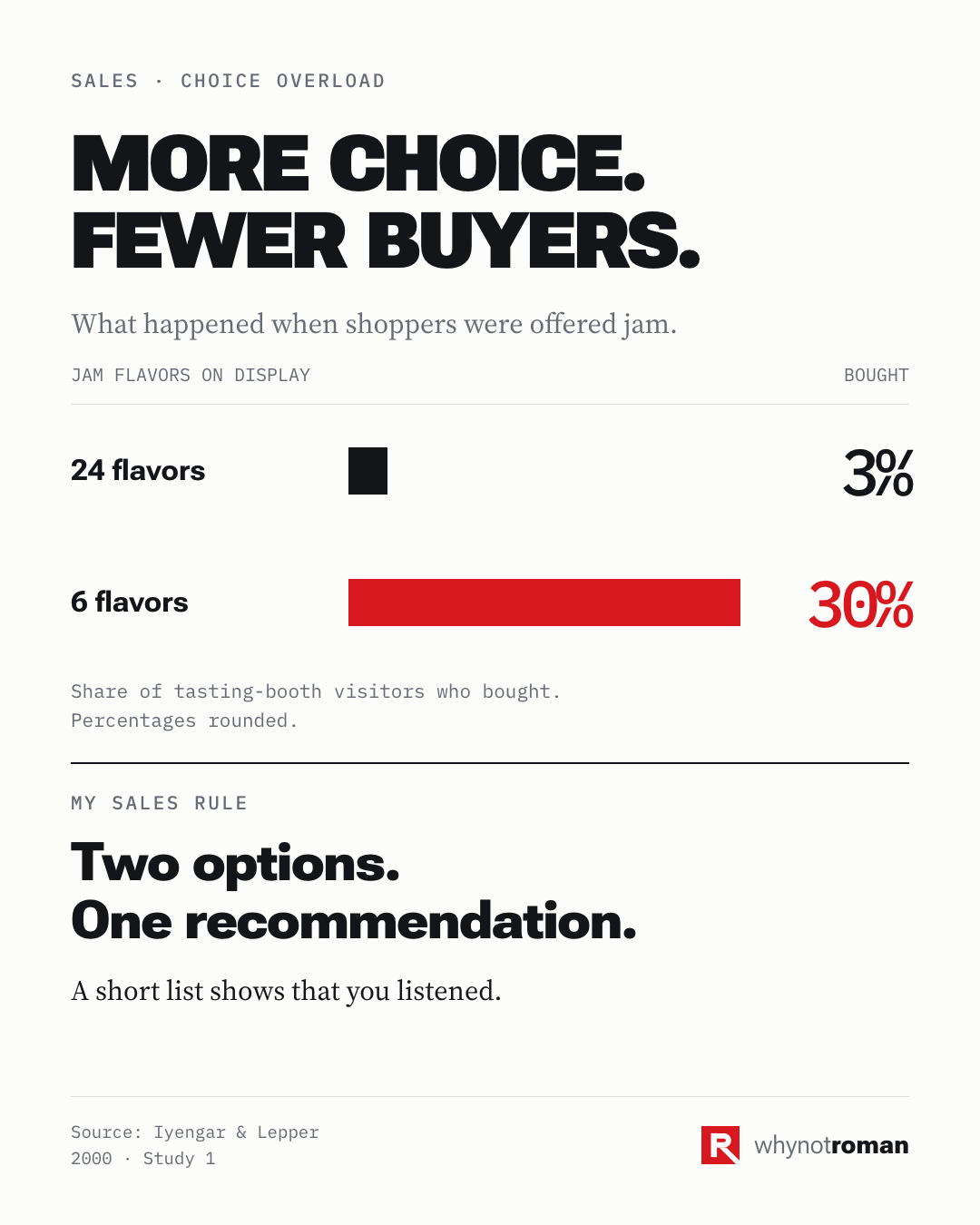
Source: Iyengar and Lepper (2000), Study 1, page 997. Percentages are rounded and refer to shoppers who stopped at the tasting booth: 4 of 145 and 31 of 104. The two-option rule is my approach to sales; the study did not test it.
Read next
- Oct 20, 2026Know your stock. How knowing your cars makes moneyTwo rules for a car dealership salesperson. Know every car in stock and know the alternatives. How a lead magnet differs from an alternative, what to do when a customer leaves, and why to write down refusals.2 min
- Nov 18, 2026
Service review No. 19AutoAlert review. The platform that finds customers who may benefit from replacing their carAlertMiner signals, AI assistants and the PureCars integration: what AutoAlert claims, which results have support, and what to check before a contract.13 min